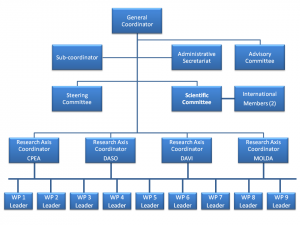
The Smart Industry Institute (ISI) will be based in the Department of Electronic Engineering of Federal University of Minas Gerais and will be organized as shown in Figure 1. The General Coordinator (Prof. Antônio de Pádua Braga, UFMG) and Sub-coordinator (Prof. Fernando Antônio Campos Gomide, UNICAMP) will have the administrative support of an Administrative Secretary responsible for administrative, financial, and accounting management of the institute. The ISI organization includes an Advisory Committee, a Steering Committee, and a Scientific Committee. The Advisory Committee is formed by two renowned external scientists to be appointed by the National Institutes of Science and Technology (NIST) Program Committee. The Advisory Committee aim is to assess ISI performance yearly to provide guidance for further academic, industry, and management actions. The Steering Committee is a high level decision-making forum to address organizational, resource management, and conflicting issues. The purpose of the Scientific Committee is to provide scientific and technical advice to academic and industrial development teams. Each research axis has a Research Axis Coordinator responsible for the research and development tasks of the corresponding axis. Research Axes coordinators are: CPSU with embedded autonomy (Prof. Fernando Antônio Campos Gomide, UNICAMP), Data Acquisition and Storage (Prof. Carlos Eduardo Pedreira, UFRJ), Data Analysis and Visualization (Prof. Aluízio Fausto Ribeiro Araújo, UFPE) and Modeling Large Datasets (Prof. Antônio de Pádua Braga, UFMG). The Reseach Axis Coordinators have been appointed according to their CNPq research fellowship levels, and the CAPES grade assigned to the respective institutions.
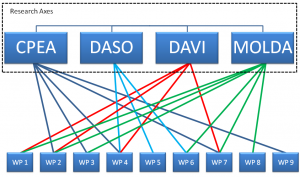
The project structure is organized into four research axes and nine work packages, as shown in Figure 2. The research axes mirrors the main research areas of ISI. The work packages details the specific approaches to be pursued by the research and development team.